
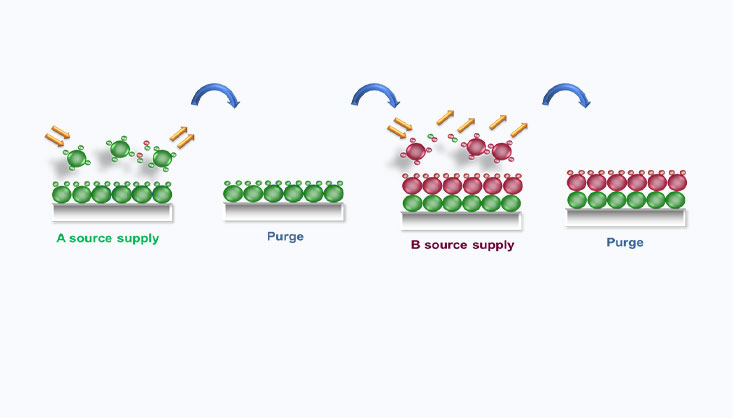
- Source Precursor Injection → Adsorption on Core Metal
- Inert Gas Purge → Removal of Unreacted By-products
- Reactant Gas Injection (O, N, H, NH etc) → Atomic Layer Deposition
- Inert Gas Purge → Removal of Unreacted By-products
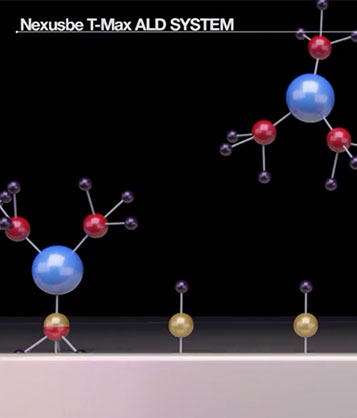
Source Precursor Adsorption
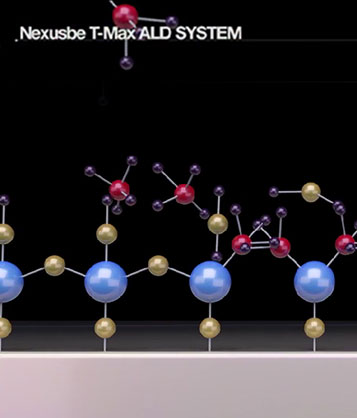
Source Precursor Adsorption
- Capable of precise atomic-layer thickness control via deposition cycle adjustment
- Capable of depositing various thin films including oxides, nitrides, and metals
- Superior deposition uniformity and high-purity film formation
- High-quality thin-film deposition on nano-scale fine patterns and 3D structures through conformal coating
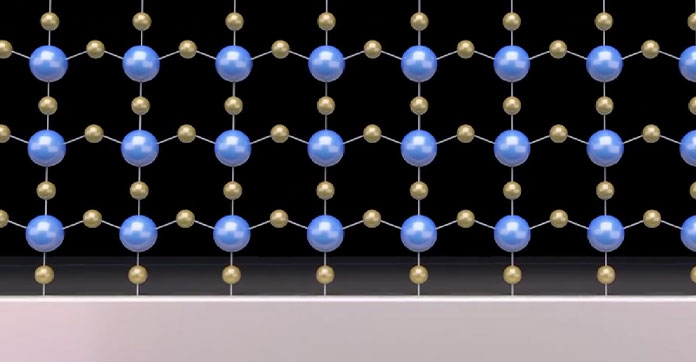
Achieving the Target Thickness through Precise Multilayer Deposition

achieving High-Quality Thin Film Deposition

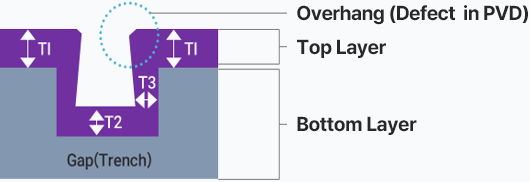
An increase in leakage current leads to higher power consumption.
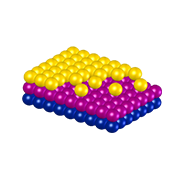
Atomic Level Control

Low temperature
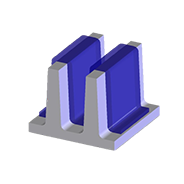
Excellent Step Coverage
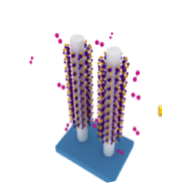
3D Structure
low temperatures and on complex 3D, high-aspect-ratio structures
ALD Division Technology

through Spatial and Temporal Division Technology
-
Division Method
Sequential injection of reaction gases
-
Principle
Sequential repetition of "Gas A → Purge → Gas B → Purge" within a single chamber (reactor) on a time-domain basis
-
Representative Equipment Structure
Single-wafer and Batch ALD Systems
-
Advantages
Precise control of thin film thickness ↑ / uniformity ↑
-
Suitable Processes
High-quality thin-film and multi-layer semiconductor processes for precision control
-
Division Method
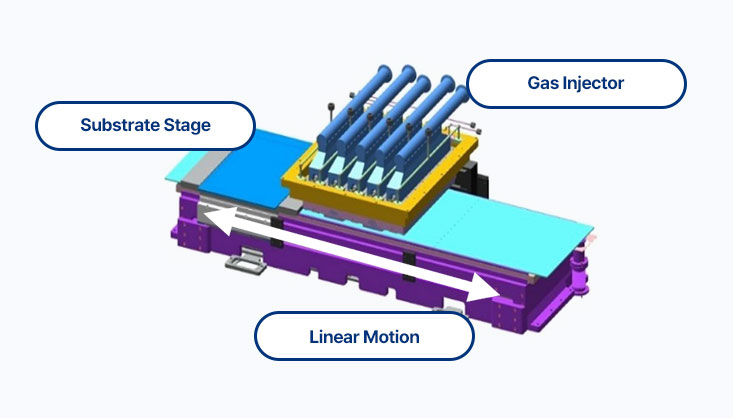
Simultaneous injection of precursors into spatially separated zones
-
Principle
Substrates pass sequentially through spatially separated gas zones (zone A/B) while in motion
-
Representative Equipment Structure
Multi-zone flow, continuous spatial reactor type
-
Advantage
Throughput ↑ / Process speed ↑
-
Suitable Processes
Mass-production, large-area substrates for displays and Perovskite solar cells
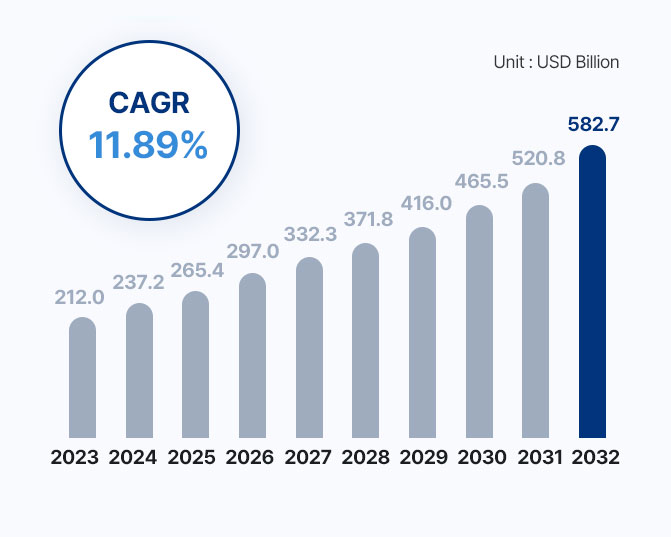
ALD Market Size

with the Atomic Layer Deposition market size expanding to USD 58.2 billion.